
Free woodworking plans to build a wall-mounted can organizer for storing, rotating, and organizing canned food. Simple enough to build in an afternoon and does not require power saws.
- 2 foot by 2 foot wall-mounted FIFO can organizer, 39 cans total
- Four lanes for standard 15 oz cans (8 each), one narrow lane for 5 oz tuna cans (7)
- New cans load at the top, oldest cans roll to the bottom and get used first
- No power saws required: a hand saw and a drill are all you need
- Covers roughly 9 to 10 days of complete meals for one person, 7 to 8 days for two
About the TBS Can Rotator
I built this during the COVID lockdowns in the NYC area when I wanted to make sure I had enough food on hand if things got tighter. I had been keeping about a week of fresh food, another week of frozen, and then some canned and dry goods as a backup, but my canned food game was pretty weak. I wanted to come up with a better system.
I wanted a canned food organizer that:
- Had a FIFO (first in first out) design so that older cans get used first
- Did not take up a lot of space and could be hung on a wall if you do not have a pantry
- Was easy to build without a lot of tools or experience
- Did not cost a lot to make
- Could provide at least one well-balanced meal a day for 1 week for one person
This is what I came up with.

It is a 2x2 foot wall-mounted can dispenser with 5 compartments: 4 for standard 15 oz cans and 1 for 5 oz tuna-sized cans. Each 15 oz column holds 8 cans and the tuna column holds 7, for a total of 39 cans. Pull from the bottom to use a can. Load new cans at the top. The oldest can is always next out.
Meal Plan
With some pantry staples alongside the organizer, including rice, oatmeal, peanut butter, jelly, and whole grain crackers, the TBS 2x2 Can Rotator can support around 1,600 to 2,000 calories a day with the following meals:
Breakfast: 1 cup dry oatmeal cooked in water with 2 tablespoons of peanut butter.
Lunch: 1 cup instant brown rice with half a can of tuna fish.
Snacks: 2 whole wheat crackers with peanut butter and jelly, trail mix and canned fruit.
Dinner: Half a can of non-starchy vegetables (green beans or mixed veggies), half a can of beans (garbanzo beans), half a can of no-bean chili.
You may want to stock your Can Rotator differently based on what you actually cook and eat. The key is stocking it with things you use in regular meals so the cans rotate and stay fresh. More on that in the companion post.
What You'll Need
I chose materials available at my local Home Depot. All cuts can be made with a hand saw or have the store cut them for you.
Materials & Tools
Disclosure: This post contains affiliate links. If you purchase through a link on this site I may earn a small commission at no extra cost to you. As an Amazon Associate I earn from qualifying purchases.
Materials
Tools
Also Needed
- Tape measure
- Straight edge
- Pencil
- Hammer
Not sure which Kreg jig to buy? See my Kreg jig comparison post for guidance. The Mini works fine for this project and is the cheapest option.
Build Steps
Attach the Lip to the Bottom

Drill the pocket holes on the 1-1/2" side of the 1x2 board. It is a short board so it is a little tricky to clamp, but it works. If you are using the Kreg Mini, the base of the jig goes flush against the end of the board. See my Kreg Mini Cheat Sheet for more detail on the setup.
Apply a thin layer of glue on the side of the 1x2 that presses against the 1x6 bottom board. Position the lip flush with the front edge as shown, then join with 1-1/4" Kreg pocket screws.
Attach the Back to the Bottom

Drill 5 or 6 evenly spaced pocket holes along the bottom back edge of the 2x2 plywood as shown. Apply glue along the edge and secure it to the bottom board using 1-1/4" screws.
Attach the Sides

Drill 2 pocket holes on the bottom of each side panel and 5 to 6 holes along the long back edge as shown. Apply wood glue to the back and bottom edges and attach each side flush to the back and bottom using 1-1/4" Kreg screws.
Attach the Center Dividers

The center dividers are 1/2" thick so use 1" Kreg screws. With the Kreg Mini, the jig will stick out 1/4" from the wood rather than sitting flush. You can use a 1/4" spacer, or stack 4 pennies as a spacer if you do not have one handy. It gets close enough. See my post on using a Kreg Mini for more detail. Place the holes 2 on the bottom and 5 to 6 on the back, same as the sides.

Space the dividers to create the columns. The thin tuna lane needs 1-5/8" of space. The four standard lanes are 4-3/4" each, except the one next to the tuna lane which is slightly narrower since we borrowed 1-1/8" from it. Apply glue to the back and bottom edges of each divider and screw into place with the 1" screws.
Attach the Front Slats
I originally planned to use a clear 18x24" acrylic sheet for the front, which would have looked nice and given a full view of the cans. But it was not ideal: when a column is empty and you are loading cans, the can drops a long way and could damage the organizer or dent the can. The slats hold cans in place, still let you see what is in there, and let you guide cans down gently when refilling. They also ended up being cheaper than acrylic.
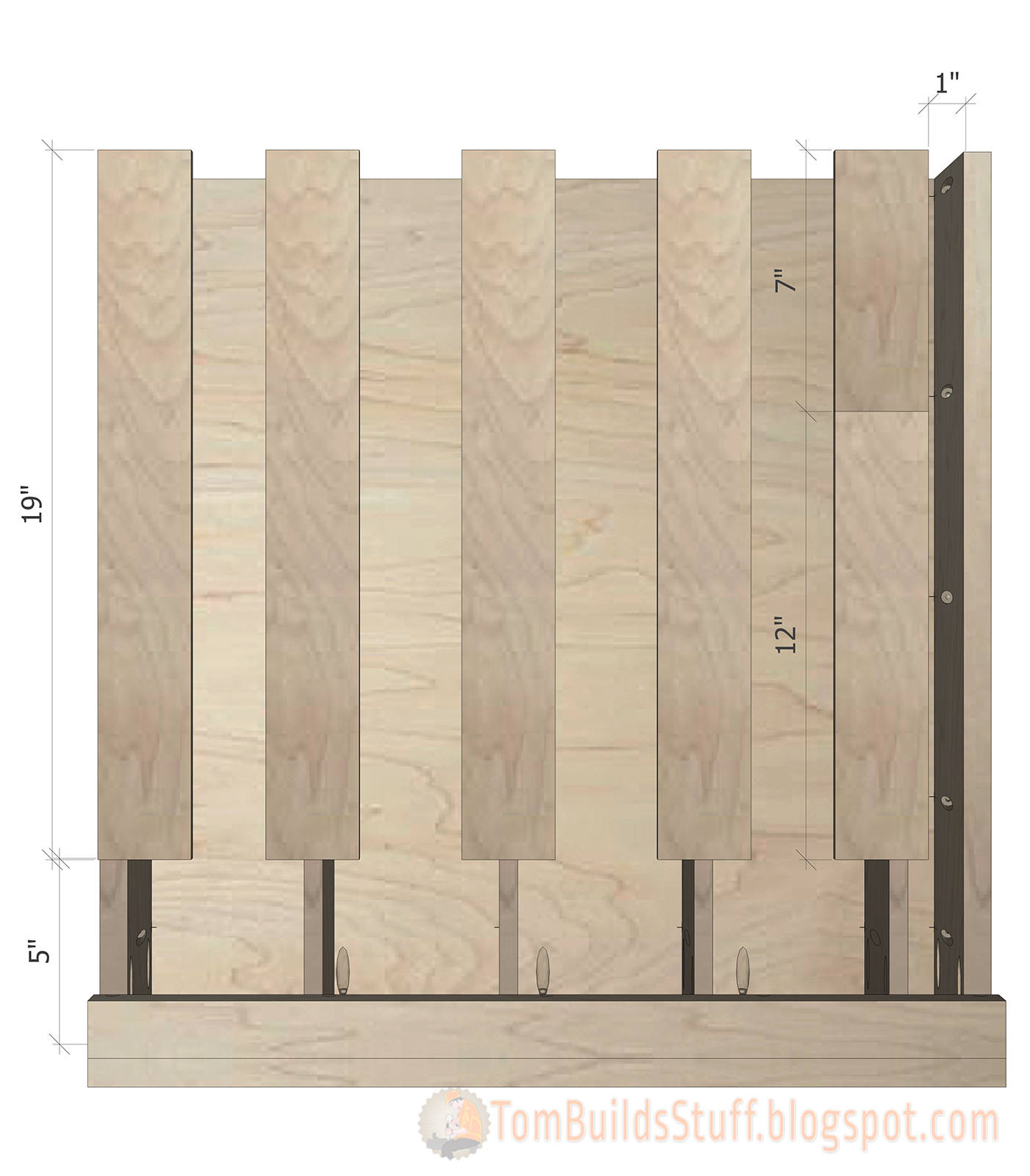
The 1/4" boards are 19" long, except the last one which uses the two 10" leftover pieces from cutting the other slats. Attach them to the sides and dividers with wood glue and 1-1/4" nails. Drill pilot holes before nailing to avoid splitting the thin stock.
My Pantry Can Organizer
The plans above are for a self-contained wall-mounted unit. I could not fit that exact design into my own pantry so I used the same components and layout but adapted it to fit my available shelf space. I also made a mistake ordering the 1/4" boards and got 1/4x4 instead of 1/4x3, so it looks a little different than the plans.
It is also a little deeper since I used existing shelf slats to screw the dividers into rather than building the full back panel. The cans do not stack as neatly but it works as intended, and I was able to fit in an extra can. Still needs some sanding, hole filling, and paint but it is doing the job.
My rotation rule: pull one can from the bottom every month and use it in a recipe, then replace it with a new can at the top. That way nothing in the organizer is ever more than about a year old.

Frequently Asked Questions
The Kreg jig is the easiest option for this build but it is not the only one. You could use finish nails and glue throughout if you do not have a jig, though the joints will not be quite as strong. Wood screws driven at an angle (toe-screwing) also work and need no special tool. The back panel attachment to the bottom and sides is the most structurally important joint. If you skip the jig, make sure those joints get both glue and screws. The front slats are just glue and nails regardless.
For a pantry application I would go with a water-based polyurethane or a simple wipe-on finish. It is going to be in a food storage area so you want something that does not off-gas once cured. Two coats of water-based poly, sanded lightly between coats, gives a clean durable surface. Paint works fine too if you want it to blend in with the pantry walls. Prime first if you are painting poplar since it tends to blotch without a primer coat.
Yes. The standard 15 oz can is about 3" in diameter, so the 4-3/4" lane width gives you about 1-3/4" of clearance for easy loading and rolling. If you want to stock 28 oz cans (about 4-1/8" diameter), widen each lane to around 5-1/2". The overall depth of the organizer (the back-to-front dimension) is determined by the height of the side boards: the current 1x4 at 3-1/2" actual width is tight for stacking 8 standard cans. If you want more capacity per lane, use wider side boards and a taller back panel.
A loaded organizer with 39 cans weighs roughly 40 to 50 pounds. That needs to go into studs, not just drywall anchors. Find two studs and drive 2-1/2" or 3" screws through the back panel into them. If the studs do not line up with a convenient mounting position, attach a horizontal cleat to the studs first and hang the organizer from the cleat. The back panel has enough surface area that you have flexibility on screw placement.
Definitely. The design scales horizontally without any structural changes: just add more dividers and wider back and bottom panels. A 2x4 foot version (doubling the width) would hold about 78 cans and covers closer to 3 weeks for one person. The 2x2 footprint was chosen to keep it manageable as a single-person build and fit in most pantry spaces, but there is nothing magic about those dimensions.
The short answer: whatever you already cook with, so it rotates naturally. My current setup is fruit in Lane 1, non-starchy vegetables in Lane 2, beans in Lane 3, and no-bean chili in Lane 4, with the small lane for tuna and other small-can proteins. I wrote a full companion post on this, including what to stock, how long it actually lasts, and how to eat from it during different emergency scenarios.
Read: Prepared, Not Paranoid: A Practical Emergency Food Plan for Normal People
Comments (8)
Join the Discussion (8)